Buy it once, get paid for it over and over again — that’s a business model I never stop loving.
Tayo Lanlehin couldn’t find kid-sized tables and chairs for her son’s first birthday. So she ordered four styles from overseas, stashed them in her basement, and started an Instagram page(opens in new tab).
Four years later, BayAreaKidsRentals.com(opens in new tab) is a $295,000 business(opens in new tab) with ball pits, bounce houses, plushie-making stations, two 16-foot trucks, and a 3,500 square foot warehouse — and she still works a full-time job.
Here’s how she built it.
Tune in to Episode 755 of the Side Hustle Show to learn:
- how to get your first rental clients through cold outreach
- how to price rental items so they pay for themselves
- how to build a team so the business runs without you
Download Your Free Bonus: 25 Other Unconventional Rental Ideas
25 Other Unconventional Rental Ideas
What else could you rent out for a profit? Here are some ideas!
Enter your email to download the full list now:
You’ll also receive my best side hustle tips and weekly-ish newsletter. Opt-out anytime.
Sponsors
- Quo (formerly OpenPhone)(opens in new tab) — Try it for free!
- Shopify(opens in new tab) — Sign up for a $1 per month trial!

- Gusto(opens in new tab) — Get 3 months free of the leading payroll, benefits, and HR provider for modern small businesses!

- Indeed(opens in new tab) – Start hiring NOW with a $75 sponsored job credit to upgrade your job post!

- Monarch(opens in new tab) — Get an extended 30-day free trial!

How She Started a Kids Rental Business
Tayo was planning her son’s first birthday. The theme was “First Trip Around the Sun.”
“Kids are very visual,” she said. “You want to immerse them into a world of the theme that you’re going for.”
But when she went looking for furniture to match, all she could find were plain white plastic chairs. Nothing kid-sized. Nothing that fit a theme.
So she asked herself the question that starts most good businesses: What if I brought this to the Bay Area?
Starting With a $2,000 Inventory Test
She didn’t buy a warehouse full of product. She bought chairs.
Four styles, 20 of each, ordered from overseas — roughly $2,000. Storage was the empty 1,000 square foot basement in her house.
Then she set up an Instagram page and started emailing local event planners.
The planners wrote back fast — and immediately asked for packages that included tables. But when she didn’t have any, she bought tables, plus a few custom styles.
How to Get Your First Rental Clients
Tayo didn’t wait for demand to find her. Three moves did most of the work.
1. Naming the business after the search
When she was hunting for items herself, she didn’t even know what to call them.
So she asked what a parent would type into Google — and named the company Bay Area Kids Rentals.
2. Going straight to the people her customers already hire
She built a list of every event planner she could find online, followed them, and sent photos, a price list “like a menu,” and a short intro to herself and the business.
3. Shooting her shot with a big name
She emailed the wife of an NBA player, noticed her daughter’s birthday was coming up, and attached what she had.
The reply came the same day: I’m going to put you in touch with our event planner.
Later, that planner told her something better than a booking: “You were actually already on our radar.”
Why Event Planners Are the Best Customer in a Rental Business
Planners in her market run events from $500 to $80,000 for a single kid’s birthday(opens in new tab).
And before Tayo existed, they had a problem: they had to buy these items for clients, then figure out how to get rid of them afterward.
“We’re so glad you’re here,” one told her, “because now it can be sustainable, we can rent, and you also have different types of styles and a variety.”
One planner books dozens of parties a year. One happy planner is a pipeline.
The Instagram Strategy That Drives Bookings
Instagram is still her biggest source of leads and visibility. A few things made it work:
- Her first post was an unboxing – “Look, Bay Area — we have kids tables and chairs now.”
- She filmed her first event herself – Setup, party, the whole thing. It got a lot of views, because nobody had seen it before.
- She collaborated on styled shoots with planners and venues, which got her tagged by vendors with real followings — and a few shoots into magazines.
- Then the tagging snowballed – Planners tag her. Guests tag her. Other vendors tag her. Eventually people want to be on her page.
At nearly 10,000 followers, the account has become something more useful than a portfolio: Bay Area parents use it as an inspiration board and a vendor directory(opens in new tab).
New followers show up already seeing that half their kid’s friends’ parents follow her.
She learned the content habit in an earlier business — a travel experience company running trips in Africa, where she always brought a photographer and videographer. “If you didn’t take videos and pictures, did it actually happen?”
She also invested in SEO(opens in new tab), which sends leads directly to the site, where parents can book themselves.
The Referral Engine Nobody Talks About
Here’s the part that’s easy to miss: the guests at the party are your ideal customers.
Do something spectacular and different, and every parent in the room is going to ask who supplied it.
Tayo sees it in the data. A booking comes in from parents who work in one particular industry — and that same evening, three more bookings arrive from that same industry or neighborhood.
Rental Pricing: How to Know If an Item Will Pay for Itself
Chairs rent for around $10 each, with pricing subject to change.
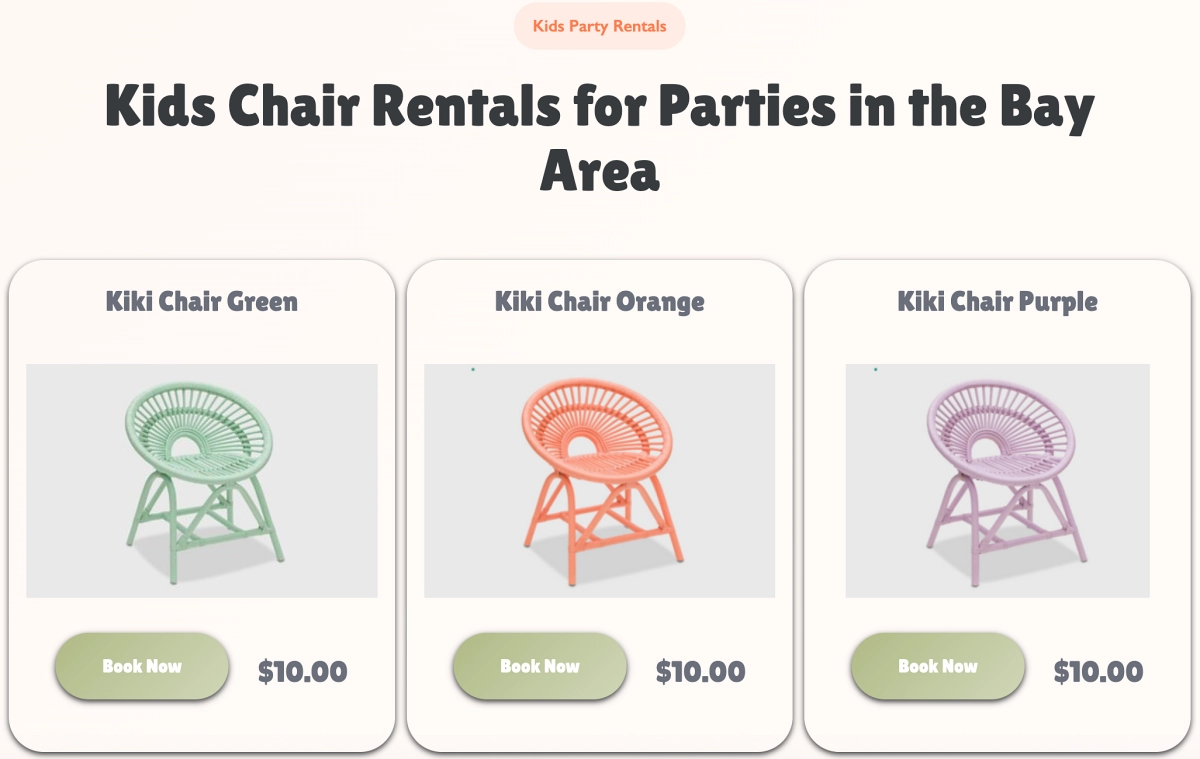
Tayo’s goal is to earn back what she paid for an item in about six rentals. That’s before maintenance, which is a real cost when kids are involved.
Her items need to look Instagram-ready, so touch-up paint is an ongoing labor expense.
The good news is the shelf life. She says her garden bow chairs still look brand new after maybe 30 or 40 events.
Delivery: From Her Own Car to Two 16-Foot Trucks
- Two events delivered in her own car — then, “okay, we need something else”
- Hired a driver who had his own small truck
- Added a transit van within a couple of months
- Today: a transit van and two 16-foot trucks
She charges a delivery fee based on mileage, which covers running the vehicles and insuring them — and beats the hassle of renting a U-Haul(opens in new tab) every weekend.
Buying Inventory in Collections
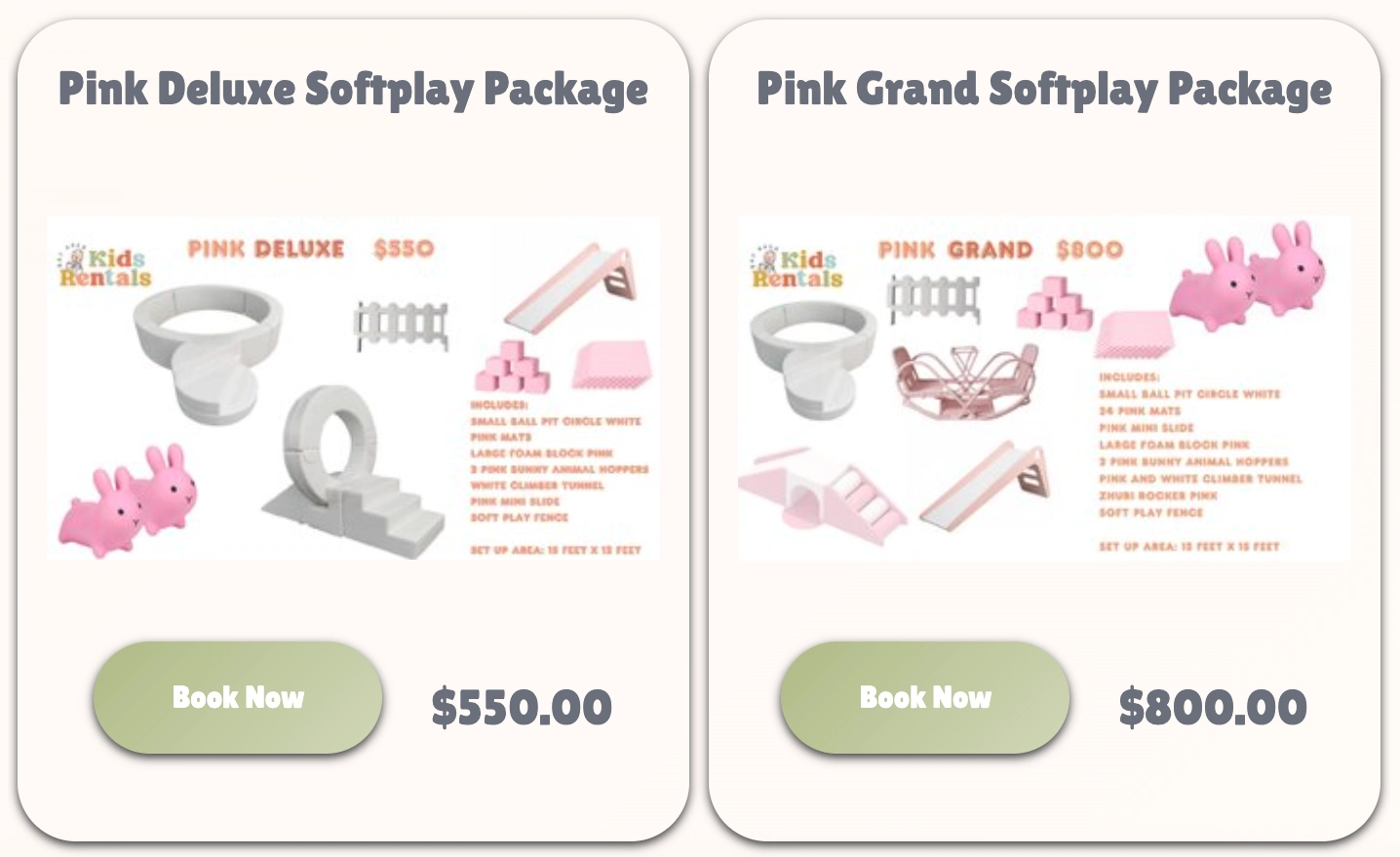
Most of her inventory now gets released as collections. She studies trending party themes and color palettes, then buys tables and chairs to match.
At the time we talked, camping themes were hot (think Parent Trap), Toy Story was back thanks to the new movie, and back-to-school was in season. Carnival themes never die.
Her star-shaped purple ball pit? Inspired by Taylor Swift parties.
She also uses a smart risk-reducer: because people book up to six months out, she lists new items on the website before they arrive. Demand shows up first, inventory second.
Expanding From Chairs to a One-Stop Party Shop
Clients kept asking: do you have bounce houses(opens in new tab)? Ball pits?

She couldn’t buy everything, so she prioritized. Ball pits came first — partly because she wanted to break into corporate “bring your kids to work” events. The two grand ball pits are big: one 13 feet across, the other roughly 13 by 10.
Then more ball pits, bounce houses in multiple colors, and customized activity workshops. The newest is a plushie-making setup — essentially Build-A-Bear on site, backdrop and all, where kids stuff their own plushie and decorate a T-shirt.
The reason is simple: busy parents want one vendor and one delivery. Less coordination for them, more rentals per booking for her.
Average booking now runs $1,000 to $1,500. Big ones hit $8,000 — a plushie workshop for 40 kids, plus a ball pit, plus tables and chairs.
Storage, Insurance, and Overhead
Adding inflatables(opens in new tab) raised her insurance costs a lot.
Storage grew fast too. Tayo went from the basement to a 1,200-square-foot warehouse behind her house to a commercial space of about 3,500 square feet that she moved into recently.
Payment terms help with cash flow: a 50% deposit to reserve the items, then the remaining balance one week before the event.
How She Runs It Around a Full-Time Job
Tayo has a manager, drivers, admin, and customer service assistants, and a social media manager. The team runs the business. She owns it.
That’s what makes a multi-six-figure operation survivable alongside a full-time job — especially in a business where the work happens on evenings and weekends, which is family time.
Her hardest problem isn’t demand. It’s hiring. “It’s been very, very tough to find just the right talent” — people who understand the aesthetics, the design-forward standard, the level of perfection this clientele expects.
Tools/Tech
-
- Event Rental Systems>(opens in new tab)– booking software that tracks inventory, dates, and deliveries
- Connecteam(opens in new tab) – team communication, similar to Slack
Her husband is a CFO and handles payment processing.
What She’d Do Differently
Tayo would start with more items, sooner.
She began with only chairs, which meant guests could sit but couldn’t do anything else. If she started over, she’d go in with a one-stop-shop mindset from day one.
That doesn’t mean buying everything. A few chairs, a few tables, a few bounce houses, and a few ball pits would do it. People like packages, and they like dealing with one company.
Mistakes or Surprises?
Tayo shared two stories from opposite ends.
The good one: an early client’s grandfather was the CEO of Apple, and she got to meet him at his house. That’s when it hit her what kind of clientele the business was attracting.
The rough one: earlier this year, one of her trucks was stolen from her old warehouse. She walked in, saw the gate open, and the truck gone.
Insurance takes a while, so she bought a replacement truck to keep deliveries running. The original was eventually found. Now she has both, and she says she needs them.
What’s Next for Tayo?
Franchising(opens in new tab). She already has one franchise up and running and is vetting more operators.
Her take: if you find the right operator, you can grow much faster than trying to keep everything company-owned. She’d rather partner with people who are eager and ready to move than overthink the expansion.
“If you have the right operator as a franchise, you can really move much quicker.”
A brick-and-mortar party venue is also on the table, though that’s still in the analysis phase.
Tayo’s #1 Tip for Side Hustle Nation
“Try to understand the sector very well. Just start. Don’t overthink it. Bringing your own self into your work.”
25 Other Unconventional Rental Ideas
What else could you rent out for a profit? Here are some ideas!
Enter your email to download the full list now:
You’ll also receive my best side hustle tips and weekly-ish newsletter. Opt-out anytime.
Episode Links
- BayAreaKidsRentals.com(opens in new tab)
- Bay Area Kids Rentals Instagram page>(opens in new tab)
- CNBC News on Bay Area Kids Rentals(opens in new tab)
- Event Rental Systems(opens in new tab)
- Connecteam(opens in new tab)
- 14 Ways to Make Money With a Truck: Up to $1,000 a Day!(opens in new tab)
- Episode 718: Does it Make Sense to Buy a Franchise as a Side Hustle?, with Greg Mohr>(opens in new tab)
- Episode 692: How to Build a Profitable Online Directory, with Frey Chu>(opens in new tab)
- Episode 684: $500 Per Client Per Month: Building a Six-Figure Local SEO Side Hustle, with Eric Dingler(opens in new tab)
- Episode 676: This PE Teacher Started a $150,000 Side Hustle Bringing Foam Parties to Kids(opens in new tab)
- Episode 280: How to Start a Bounce House Rental Business (Investing in “Inflatable” Real Estate), with Corey Jeffreys(opens in new tab)
Looking for More Side Hustle Help?
- Start Your Free $500 Challenge(opens in new tab). My free 5-day email course shows you how to add $500 to your bottom line.
- Join the free Side Hustle Nation Community(opens in new tab). The free Facebook group is the best place to connect with other side hustlers and get your questions answered.
- Download (opens in new tab)The Side Hustle Show(opens in new tab). My free podcast shares how to make extra money with actionable weekly episodes.

The award-winning Side Hustle Show is the #1 side hustle podcast
with over 1,300 5-star ratings!

Listen in your favorite podcast app or directly in your browser.