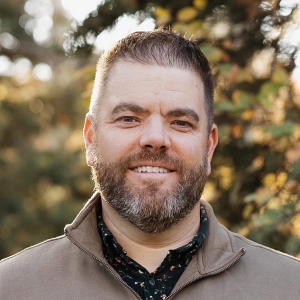
What happens when you can’t find custom cycling gear that’s actually comfortable, durable, and affordable?
If you’re Dan Hendriksen, you build the company yourself, keep a full-time job for years while you do it, and let the business quietly spin off hundreds of thousands of dollars in profit.
Dan is the co-founder of Volt Cycle Wear, a custom cycling apparel business that’s grown into a multimillion-dollar operation serving everyone from five-person weekend riding groups to corporate accounts ordering tens of thousands of units a year.
Tune in to Episode 771 of the Side Hustle Show to learn:
- how to find and vet a manufacturing partner for a custom physical product
- the networking and event tactics that generated bulk orders with zero ad spend
- which unexpected customer segment became more than half of Volt’s customer count
Sponsors
- Freshbooks.com – Get 90% off your first 4 months!

- Shopify — Sign up for a $1 per month trial!

- Gusto — Get 3 months free of the leading payroll, benefits, and HR provider for modern small businesses!

- Indeed – Start hiring NOW with a $75 sponsored job credit to upgrade your job post!

- Monarch — Get an extended 30-day free trial!

How Volt Started as a Personal Pain Point
Dan started Volt with a friend named Kelly after getting frustrated trying to order matching kits for a group ride.
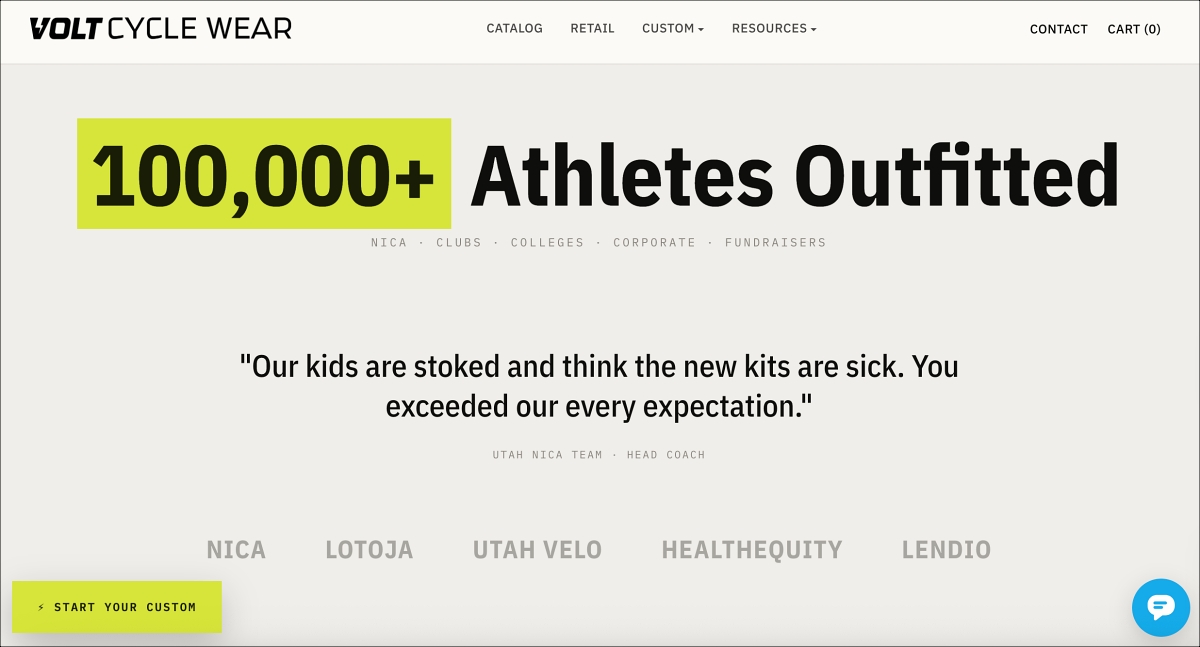
Both were lifelong cyclists who couldn’t find a good source for customized kit (the term cyclists use for what they wear). Neither had a textile background. They just knew what felt right as riders.
That first order was for a relay race from Moab to St. George, Utah — just 4 jerseys for 4 riders. Nobody wanted to make four.
So they went through close to a dozen manufacturing partners before finding one that checked all three boxes:
- Low minimums – willing to produce a handful of units, not hundreds
- Open to feedback – willing to iterate on fit and fabric until the product was actually good
- Reasonable turnaround – fast enough to keep customers happy
Once friends started asking “Where’d you get that kit?”, Dan and Kelly realized they had something bigger than a personal project.
A 150-person riding “team” they rode with agreed to give them the business, which became Volt’s first real customer — and meant the first thing they needed was a website where everyone could place their own orders.
Solving the Ordering Headache
The real unlock wasn’t just the product, it was removing the operational pain of group ordering.
Normally, whoever’s organizing a team kit has to collect money, track sizes, place the order, and hand everything out.
Volt built a model where each team or club gets a unique URL, individuals order and pay directly, and Volt fulfills each order separately. That took the “wrangling” burden off the volunteer organizer entirely.
How the pricing works:
- No minimum order quantity. A single jersey is still a single jersey; Volt will make it.
- Design fee on small orders. If Volt is doing the design and the order is under about 10 units, there’s a design fee. Hit a quantity of 10 and the fee is waived.
- Price breaks on volume. Orders in the many hundreds qualify.
- Margins target roughly 3x landed cost. A product that costs about $10 to produce typically sells for around $30.
Volt also sends out a fit kit before orders open: every product, organized in garment bags, shipped with a rack so the team can hold a “fit party” and try everything on.
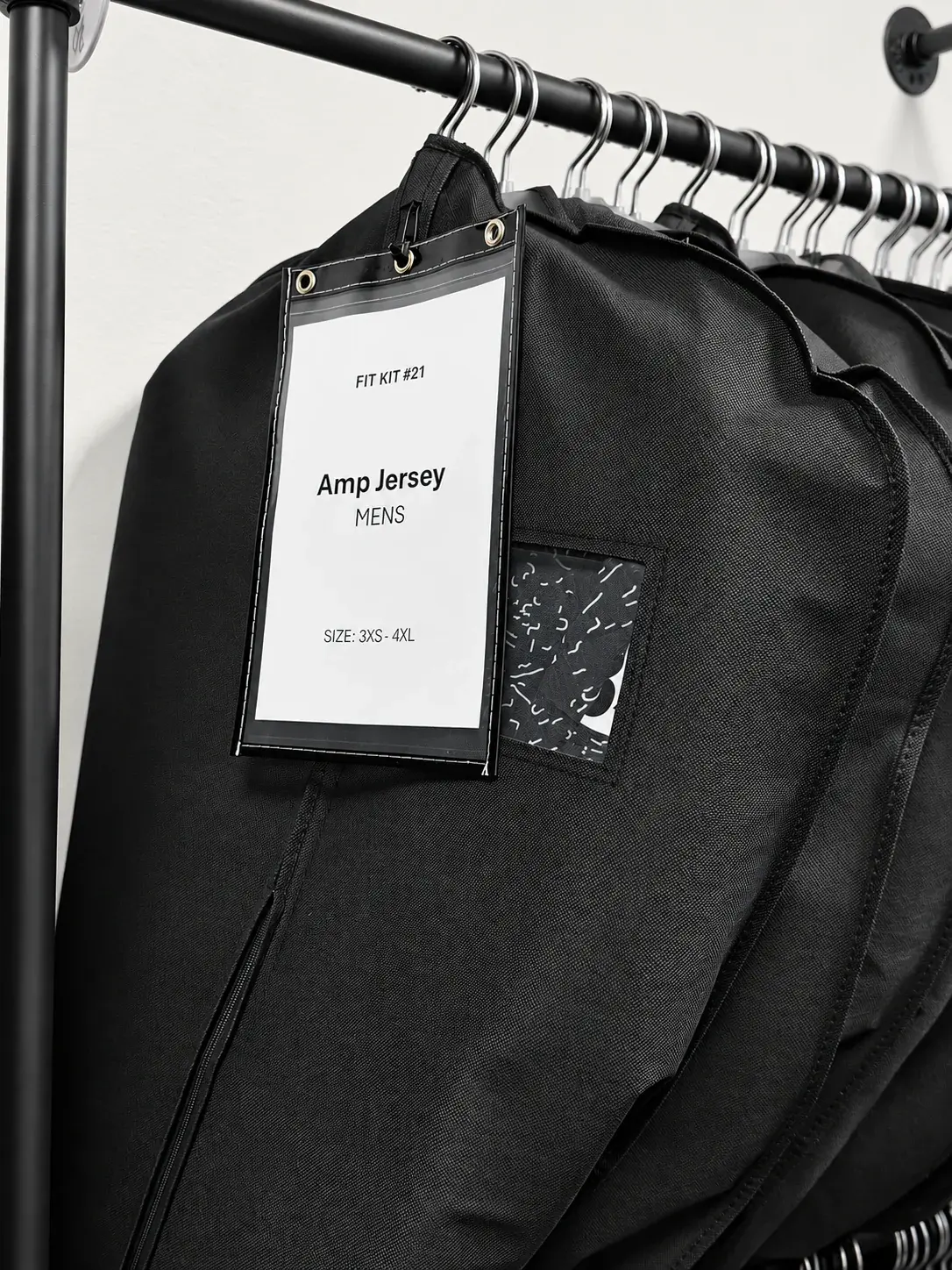
Most competitors either mail a box of random sizes or just send a sizing chart.
How Volt Found Its First Customers
Early growth came from networking, not paid marketing.
Volt ran an informal ambassador program, rewarding people financially for sending business their way, built entirely through personal connections rather than influencers.
For a version of this taken much further, Samantha Hamilton built a whole community around her Disney-inspired running skirt brand’s ambassador program.
The bigger lever was showing up at cycling events, bike races, and festivals with a free Costco Easy Up and some camping chairs.
The playbook:
- Get in free. Offer the event promoter free product or solve a pain point of theirs in exchange for a presence.
- Qualify on the spot. Scan a QR code for a free pair of socks — self-identified decision makers only, and Volt takes your word for it.
- Buy the meeting. Automated emails and texts offer a “free lunch,” which means someone on the team Venmos you $15 to hop on a call.
- Close with a question. “When can we get started on design?”
The calls work because nobody minds a phone call about their own passion. These are cyclists who love talking cycling.
The Customer Segment Nobody Expected
Dan’s own experience as a dad of 4 sons led him to local high school mountain biking teams, part of the National Interscholastic Cycling Association (NICA).
He asked a coach who made the team’s kits and got the same frustrated sigh he used to give himself.
Some of those high school teams run 250 kids deep, multiplying the ordering headache many times over compared to a handful of adult riding buddies.
That segment, found in pursuit of essentially free leads, now makes up an estimated 25 to 30% of Volt’s revenue and more than half of its total customer count.
Corporate accounts came from the same networking approach, just asking people what they do for work.
One conversation led to a client that now orders around 35,000 jerseys a year, by far Volt’s largest account.
Volt was candid about never having produced at that scale before, started smaller to build trust, and grew into the relationship as both sides learned each other’s capacity.
Managing Production and Logistics
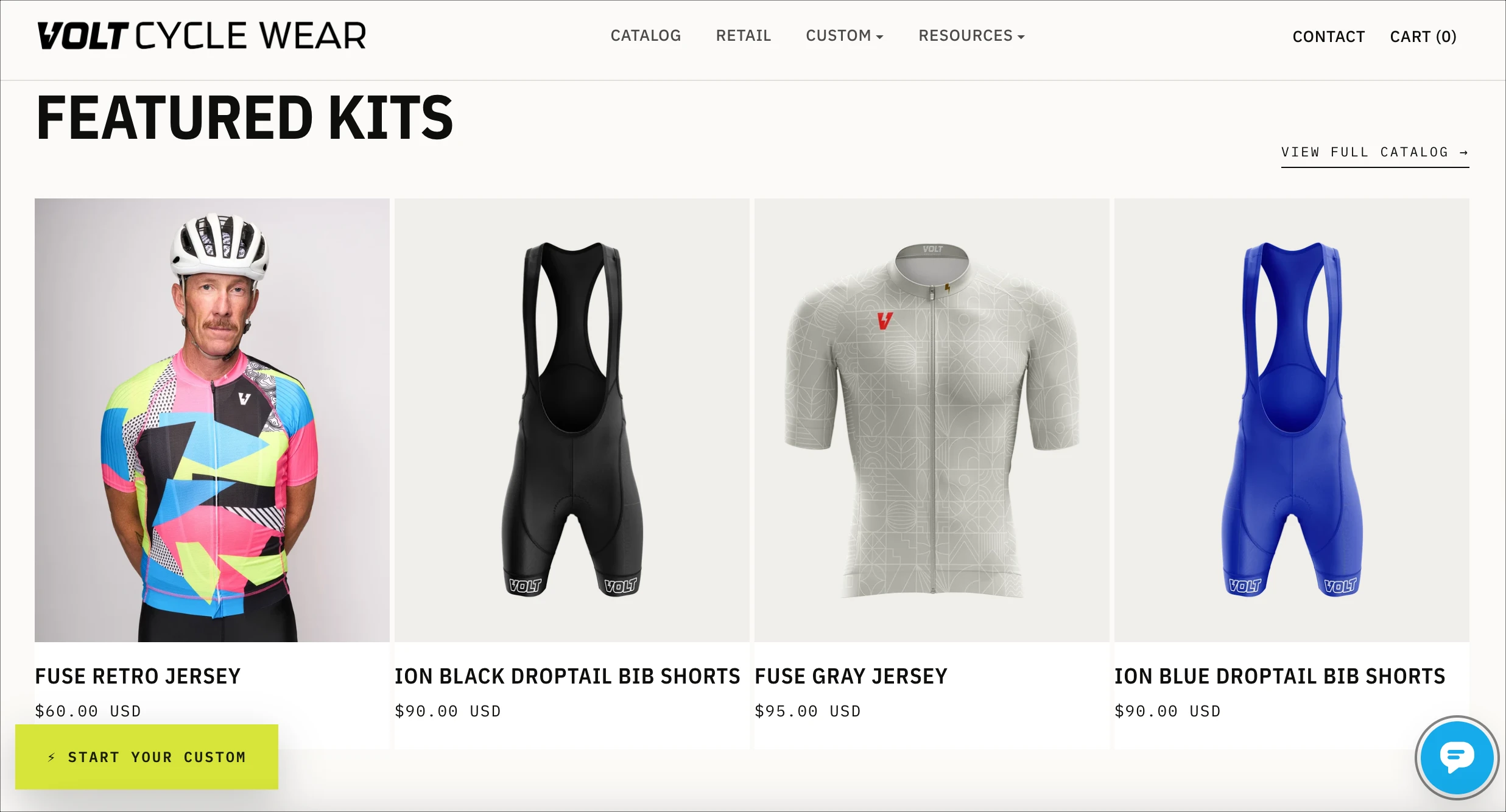
Custom orders run on a 4 to 6 week timeline, with Volt publicly promising 6 to 8 weeks to stay on the safe side. Given the sheer number of SKUs — jerseys, shorts, hoodies, socks, gloves, jackets, vests, arm and leg warmers — that’s considered fast in the space.
The approval sequence looks like this:
- Creative brief and flat file. The customer describes what they want, designs go back and forth over email until everyone agrees.
- Color flag. Volt ships out a physical board with a swatch of every color the printer can produce, so clients pick exact shades instead of trusting a screen.
- Print sample. The factory prints the design and usually sends high-res photos, sometimes shipping the physical sample to the U.S. for a final sign-off.
- Purchase order. Sizes, genders, products, barcodes, and SKUs all go over to manufacturing.
Finished goods ship in bulk to Volt’s office, where the team does quality control, then breaks a single bulk shipment down into individual orders, poly-bags them, and hands them off to USPS, UPS, or FedEx.
Worth noting on the product side: Volt uses dye sublimation, which prints across seams. It’s why the big print-on-demand suppliers can’t match these products, and it’s a different model from the heat-transfer approach in Episode 520’s print-on-demand business on Etsy.
Tools/Tech
- Shopify – core platform for the Volt storefront and order management
- W3 Order Status – Shopify plugin providing automated order status updates to customers
- AceReal form plugin – used to build the “creative brief” forms where customers upload logos and describe custom designs
- QuickBooks – financial record-keeping for the business
Mistakes to Avoid
Volt learned the hard way that colors look different on a screen than on fabric, especially lightweight, sheer materials.
That led to customer complaints about shirts coming out “more green” or “more purple” than expected, which is why the physical color swatch process now exists.
Dan also stressed under-promising and over-delivering on both timelines and new capabilities.
When a major client questioned whether Volt could handle high volume, the team was upfront that they hadn’t done it at that scale before, but worked with manufacturing partners to build a realistic plan rather than overstating what they could do.
What’s Next for Dan?
Dan is stepping away from his day job to focus on Volt full time, something he says became possible once he realized the business was generating more profit annually than his job paid him, on top of hitting a Coast FIRE-style retirement milestone.
Also on the roadmap:
- A passionate cyclist expected to tap into new networks
- New product lines, including “drop bibs,” launched this year, a bib short design that lets riders use the restroom without fully undressing
- A formal ambassador program relaunching in 2027
- On-site design tool letting customers design products directly on the website
Dan’s #1 Tip for Side Hustle Nation
“Find a problem that exists that resonates with people and solve that… find a problem that resonates with an audience of any size and solve that problem and solve it well.”
Episode Links
- Volt Cycle Wear
- Shopify
- W3 Order Status
- AceReal form plugin
- QuickBooks
- NICA
- Episode 702: Disney-Inspired Running Skirts
- Episode 520: Building a $15K/Month Print on Demand Business on Etsy
- Episode 720: How Coast FIRE Led to a 3-Day Workweek
Looking for More Side Hustle Help?
- Start Your Free $500 Challenge. My free 5-day email course shows you how to add $500 to your bottom line.
- Join the free Side Hustle Nation Community. The free Facebook group is the best place to connect with other side hustlers and get your questions answered.
- Download The Side Hustle Show. My free podcast shares how to make extra money with actionable weekly episodes.
The award-winning Side Hustle Show is the #1 side hustle podcast
with over 1,300 5-star ratings!

Listen in your favorite podcast app or directly in your browser.